Make Easy – We understand your work

ERP Systems Guidance for Structured Business Growth

ERP systems are not just software tools — they are the operational structure that connects accounting, inventory, GST, payroll, manufacturing, and reporting into a single business system.
We help growing businesses understand ERP systems clearly, plan ERP implementation strategically, and adopt structured business automation without confusion, risk, or system failure.

Make an Enquiry​
Name
Email
Subject
Select Title
Message
The form has been submitted successfully!
There has been some error while submitting the form. Please verify all form fields again.
Talk Freely

+91 80000 86938

Why Businesses Struggle Without Structured Systems

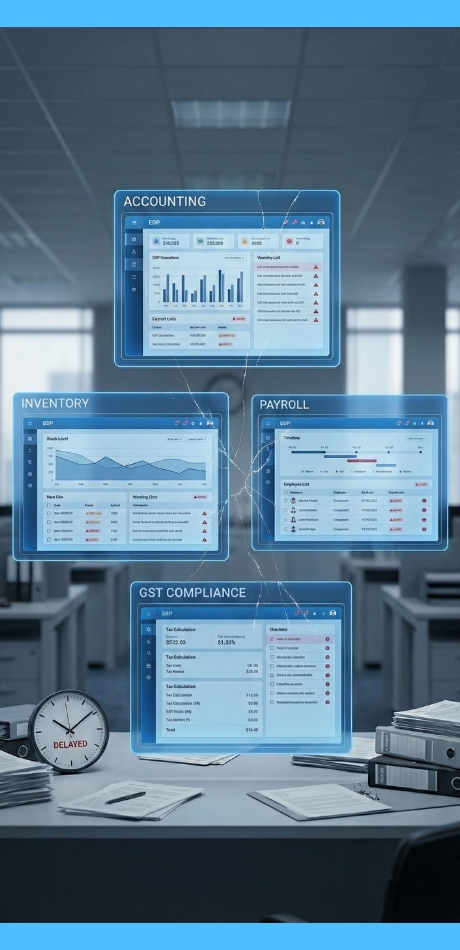
Operational gaps grow when accounting, inventory, compliance, and reporting are not connected within a unified system.

As businesses scale, manual processes and disconnected tools begin to create inefficiencies. Accounting data does not align with inventory records, GST compliance becomes reactive, payroll lacks validation, and reporting depends on scattered spreadsheets.

Without a centralized business system, decision-making slows and operational risks increase. Structured ERP systems are designed to unify these processes into a single, controlled framework — but only when implemented with clarity and planning.

What Is an ERP System in Modern Business Operations?

An ERP system (Enterprise Resource Planning system) is an integrated business management platform that connects accounting, inventory management, GST compliance, payroll processing, manufacturing operations, procurement, and reporting into a unified operational structure.

Instead of using separate software for each department, ERP systems centralize business data, standardize processes, and provide real-time visibility across all core functions.

In modern business environments, ERP systems function as the operational backbone of an organization. They enable structured business automation, reduce manual errors, improve data accuracy, and support informed decision-making through consolidated financial and operational insights.

A properly implemented ERP system aligns departments under a single system architecture, ensuring consistency, compliance, and scalable growth.

Independent ERP Consulting and Implementation Guidance​

We do not sell ERP software. We provide independent ERP consulting that helps businesses understand ERP systems before selecting or implementing them.

Our focus is structured ERP implementation planning — aligning accounting, inventory, compliance, and operational processes with the right system configuration. This approach reduces risk, prevents costly mistakes, and ensures long-term business automation stability.

Who We Help​

We work with growing manufacturing units, trading companies, distribution businesses, and service enterprises that need structured ERP systems to manage accounting, inventory, compliance, payroll, and operations in one unified business system.

ERP for Manufacturing Businesses

Structured ERP systems for production planning, inventory control, workflow automation, and real-time operational visibility.

ERP for Real Estate Companies

ERP systems integrating project tracking, financial management, compliance reporting, and payment schedule automation.

ERP for Schools and Educational Institutions

ERP systems managing admissions, fee processing, payroll, academic records, and administrative workflow integration.

ERP for Trading and Distribution Businesses

ERP systems optimizing inventory tracking, GST compliance, order management, and multi-location operational control.

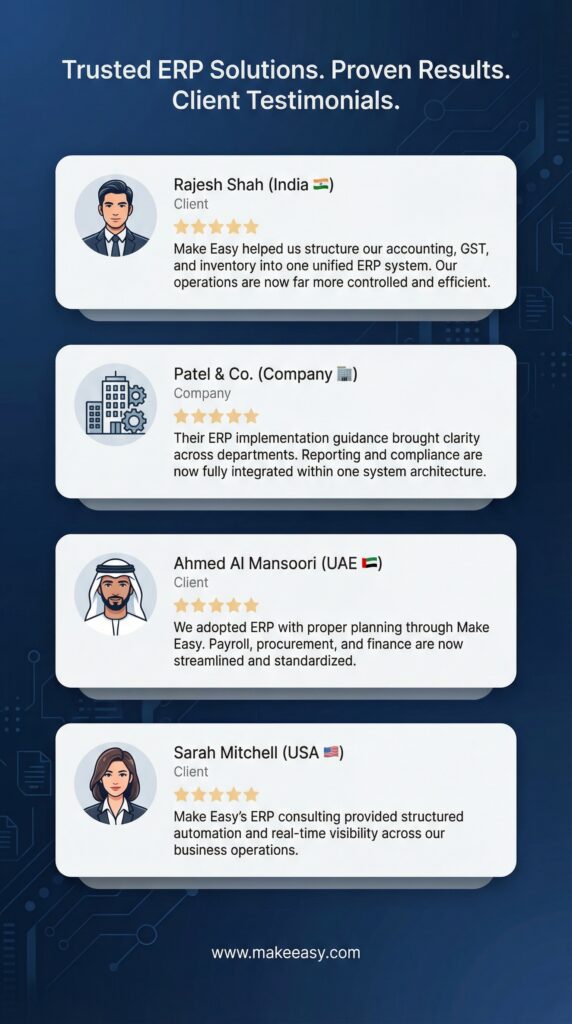
Happy Customers

Proin gravida nibh vel velit auctor aliquet. Aenean sollicitudin, lorem quis bibendum auctor, nisi elit consequat ipsum.

Why ERP Implementation Fails Without Structured Planning?

ERP implementation fails when businesses treat ERP systems as software installations instead of structured operational frameworks. Without process mapping, data alignment, role definition, and phased deployment, even the most capable ERP systems cannot deliver operational control or automation.

Many ERP projects struggle due to unclear business workflows, inconsistent financial data, lack of inventory standardization, and absence of implementation guidance. When ERP systems are deployed without aligning accounting structures, compliance requirements, reporting needs, and department-level processes, the result is confusion rather than control.

Successful ERP implementation requires structured planning, system configuration based on business logic, data discipline, and continuous process alignment — not just software activation.